
Rome Chose Caesar. What Makes Us Think We Won't?
What Julius Caesar Reveals About Power, Politics, and the Problems Plaguing Modern Society

Introduction
“The History of the World,” argued Thomas Carlyle, “was the Biography of Great Men.”1 According to this view, Universal History—the history of mankind’s accomplishments—is essentially the history of those leaders, heroes, creators, prophets, and trailblazers who achieved them.
In the case of Julius Caesar, history demonstrates not only how one man’s achievements influenced the fall of a great republic, but also how one man can mold our universal understanding of the greater dynamics of power, prosperity, and politics.
Will modern society ever actually look upon such a Great Man?
The Character of Caesar
Born 100 B.C., Gaius Julius Caesar “began and ended as a god.”2 Historian Will Durant explains how Caesar “traced his pedigree to Iulus Ascanius, son of Aeneas, son of Venus, daughter of Jupiter”.3
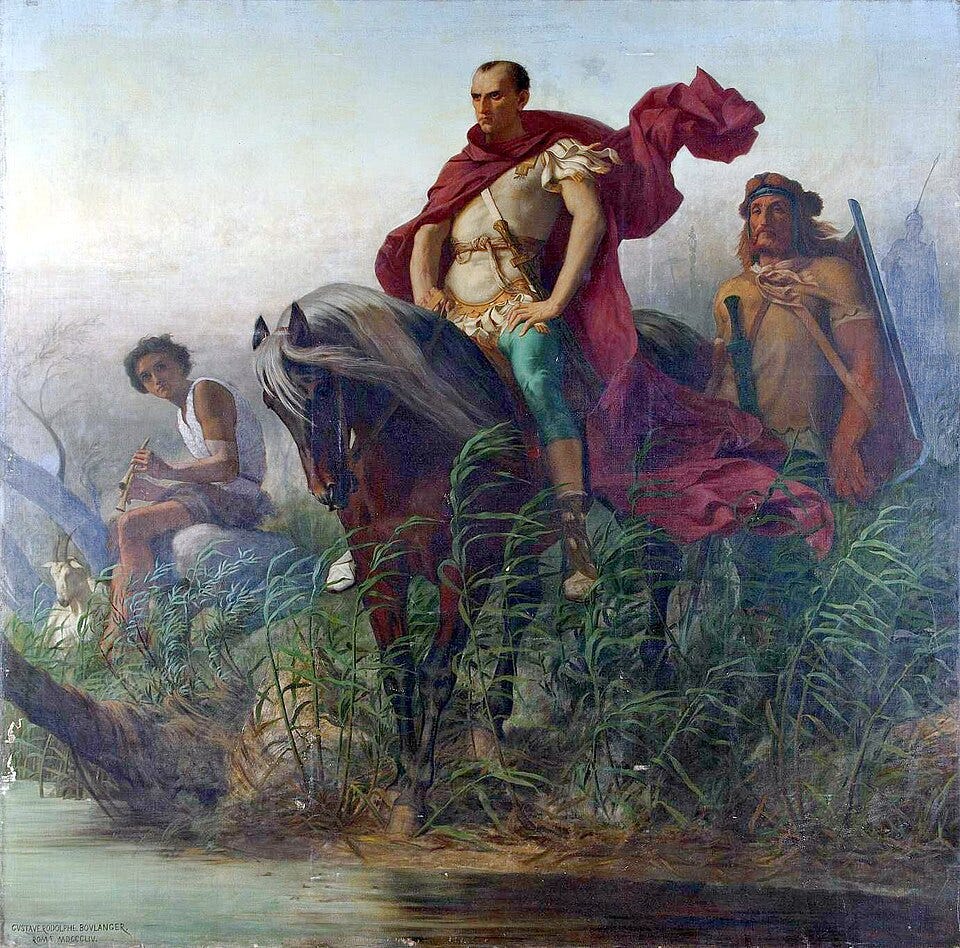
Educated in both language and oratory, he was made military aide-de-camp at nineteen to a praetor of Asia. At one point, Caesar was sent “in order to raise a fleet to assist in the siege of Mitylene.”4 But as Suetonius writes, “he wasted so much time at King Nicomedes’s court that a homosexual relationship between them was suspected, and suspicion gave place to scandal. . . .”5 Gossip surrounding this would follow him to the grave. But despite this stain on his reputation, he would be awarded civic honors for saving a fellow soldier’s life.
Back home, his relationships with women went undisturbed: “His affairs with women,” writes Suetonius, “are commonly described as numerous and extravagant,” so much so that “the Elder Curio referred to him in a speech as: ‘Every woman’s husband and every man’s wife.’”6 Doubtless these satisfied his carnal desires, but Durant notes an additional aspect of these affairs:
“Every woman he won was an influential friend, usually in the enemy’s camp; and most of them remained his devotees even when his passion had cooled to courtesy.”7
At a glance, it’s tempting to describe him as both a mere “unscrupulous politician” and “reckless rake”,8 but these labels fail to capture that scope of Caesar’s character. More than a simple flirt, Caesar fostered a deep appreciation for poetry and prose: following his capture by pirates, Plutarch tells how he “wrote poems and sundry speeches which he read aloud to them [the pirates], and those who did not admire these he would call to their faces illiterate Barbarians”.9 In Rome, crowds applauded his speeches, which many considered second only to Cicero.10 He would author and publish commentaries (some of which survive) that have perennially impressed generations of readers just as they did his own contemporaries.
Another skill he possessed was the ability to read silently. While this may seem trivial today, it was a rare skill because at the time reading and oratory went hand-in-hand; to do the former without the latter was of considerable note.
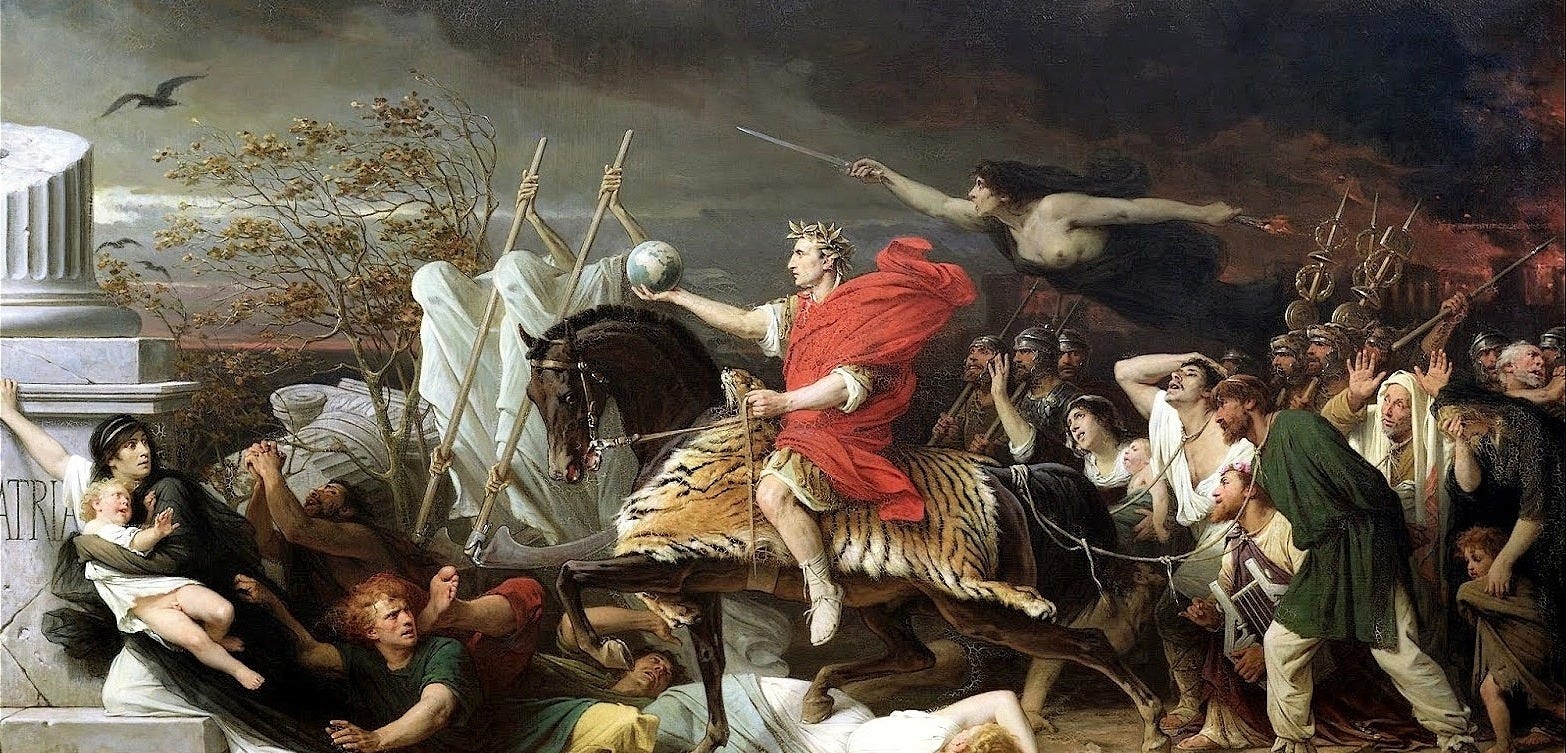
But not only intellectually astute, Caesar was a talented athlete and principled leader:
“a most skillful swordsman and horsemen, [he] showed surprising powers of endurance. He always led his army, more often on foot than in the saddle, [and] went bareheaded in sun and rain alike. . . .”11
These details help to form a more complete picture of the accomplished character that would eventually rise to power; but even still, there remains more to note.
Caesar maintained an uncanny degree of boldness: to the pirates that captured him, he “laughingly threatened to hang them all,” and even went so far as to demand that they raise his ransom.12 Being a prisoner didn’t matter. He felt above them.
After his rescue, he had the pirates crucified. Such revealed his ruthlessness, but even here he demonstrated yet another unique side of his character: before their crucifixion, he had their throats slit. In both keeping his word and sparing them prolonged suffering, Caesar’s dealing with the pirates highlights the extreme degree of brutality and mercy that a single man is capable of.
The Rise of Caesar
At thirty-two, Caesar served in Spain as quaestor, and was successful in military expeditions against native tribes. He amassed enough plunder to partially pay off his debts, and returning victorious, he threw himself again into the arena of politics and the quest for power. He was elected commissioner of public works in 65 BC; a year later, president of a commission for trying murder cases; two years later, praetor.
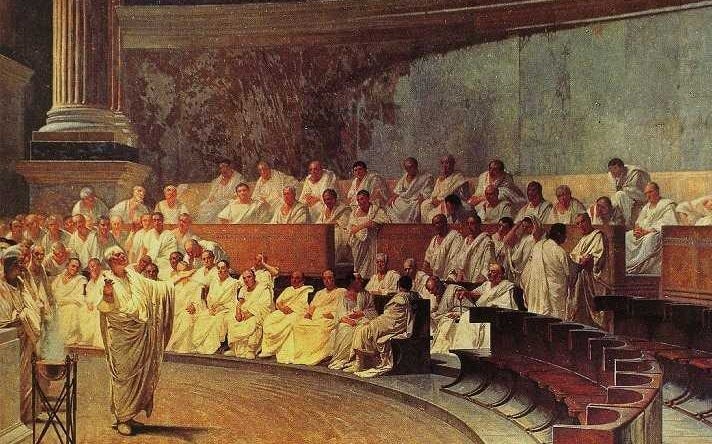
He also won the support of many influential figures, one being Marcus Licinius Crassus, the wealthiest man in Rome:
“Crassus came to his rescue by underwriting all his obligations. Caesar proceeded to Spain, led militarily brilliant campaigns against tribes with a passion for independence, and came back to Rome with spoils enough to pay off his debts and yet so enrich the Treasury that the Senate voted him a triumph.”13
Through this, Caesar would attach himself also to Pompey the Great, a general whose campaigns not only secured trade in the Mediterranean, but also led to the Roman conquest Bithynia, Pontus, and Syria, as well as pacifying Palestine and making it a client state of Rome. Additionally, Pompey had “an army personally devoted to him and capable at his word of making him dictator.”14 Pompey also married Caesar’s only daughter, Julia. So on Crassus’s dime and with Pompey’s power, Caesar conspired.
The three would form the First Triumvirate, an alliance by which each member vowed himself to oppose legislation that would prove obtrusive to any of the other three.
It’s worth noting that this alliance was informal; neither Caesar, nor Pompey, nor Crassus referred to themselves as members of the “First Triumvirate”. Nor was this anything new—pacts were at this point a time-honored tactic of Roman politics.
What makes this alliance noteworthy was just how much Crassus and Pompey despised each other. Crassus envied Pompey’s military prestige and popularity; Pompey envied Crassus’s wealth. Yet Caesar was able to unite these two bitter rivals. One can only marvel at the cunning which made such a political marriage possible.
Caesar’s Rise and Democracy’s Fall
The Triumvirs were successful in consolidating power and bypassing bureaucratic obstacles, but personal accomplishments came at great expense. As Durant writes,
“Roman politics had become an unparalleled chaos of corruption and violence.”15
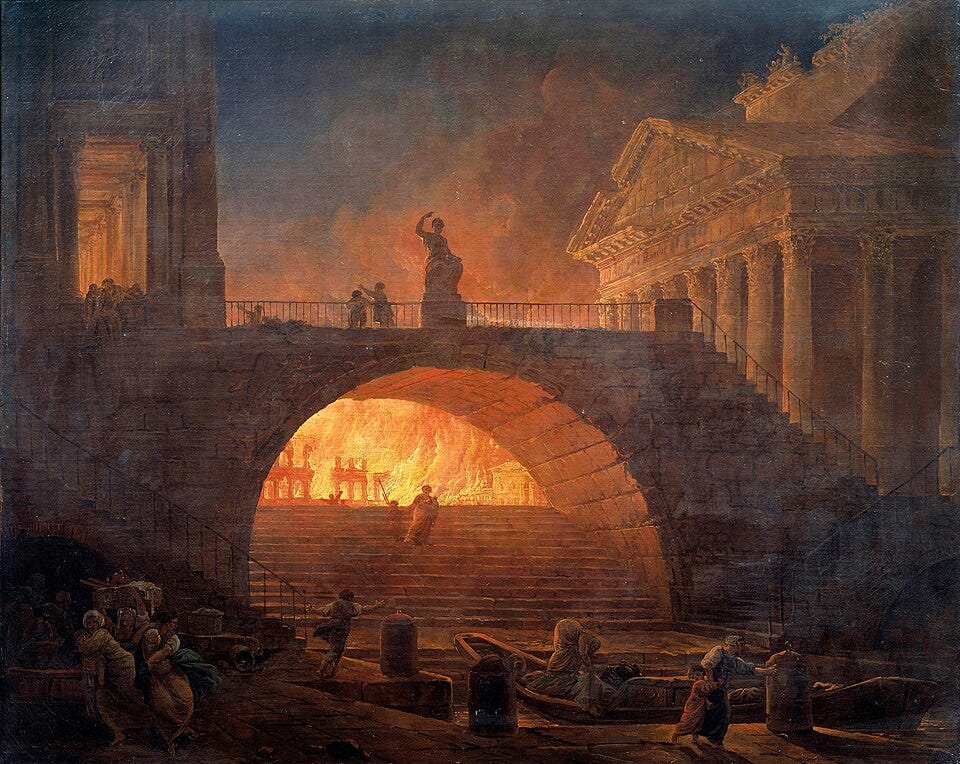
The very integrity and constitution of character which had built Rome into a dominant republic gave way to an entirely corrupt system: bribery, intimidation, and murder each became common political tactics: “Legislation came to be determined by the fluctuating superiority of rival gangs; those who voted the wrong way were, now and the, beaten within an inch of their lives, after which their houses were set afire.”16
Such a turn may surprise some; but to others, it was entirely predictable.
Predicting Human Nature
Writing some three centuries before Caesar, Plato explored the nature of civilization in his Republic. In this famous dialogue, he comes upon a timeless principle:
“Then isn’t it true that tyranny arises out of democracy in the same sort of way that democracy arises out of oligarchy?”17
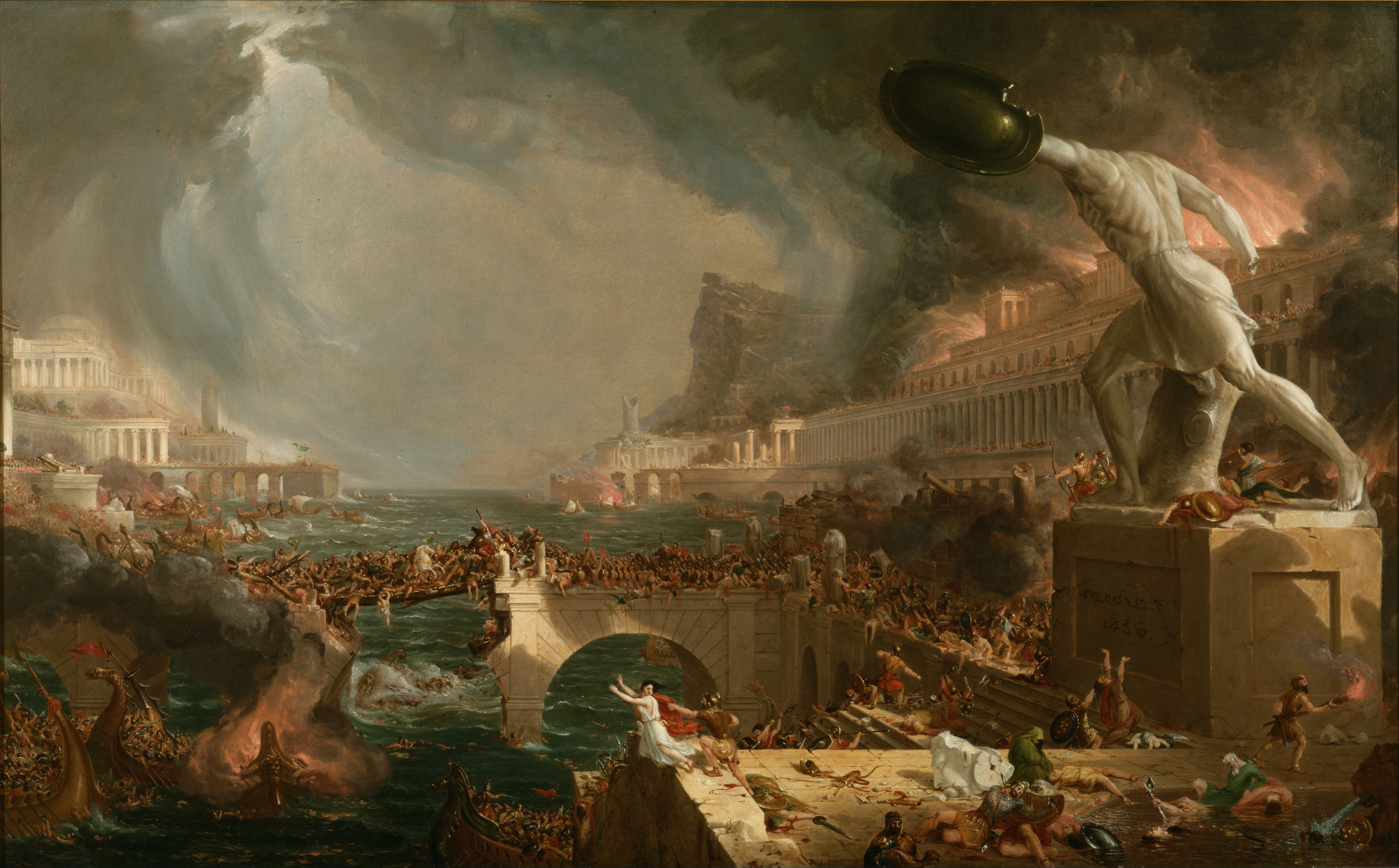
Plato argues that a civilization’s excessive desire for wealth leads to a neglect of other necessary considerations. In this way, prosperity begets the desire for liberty; in turn, the desire for liberty “at the expense of everything else is what undermines democracy and leads to the demand for tyranny.”18
Psychological theory helps explain this: According to Maslow (1943), five sets of goals motivate behavior: physiological, safety, love, self-esteem, and self-actualization. Set in a hierarchy, “the most prepotent goal will monopolize consciousness and will tend of itself to organize the recruitment of the various capacities of the organism. . . . But when a need is fairly well satisfied, the next prepotent ('higher') need emerges, in turn to dominate the conscious life and to serve as the center of organization of behavior, since gratified needs are not active motivators.”19
We can understand civilization as such: it emerges to provide physical sustenance, then safety and security. From here, love emerges and a sense of community forms. Civic responsibilities are first seen not as chores, but as labors of charity which mutually benefit all.
But as safety and security become more and more guaranteed, intergenerational value change follows;20 individual’s conscious life changes from one prioritizing the community to one prioritizing the self. Safety and security are taken for granted; liberty becomes all the more intoxicating.
As Plato argues, “citizens become so sensitive that the least vestige of restraint is resented as intolerable, till finally, as you know, in their determination to have no master they disregard all laws, written or unwritten.”21
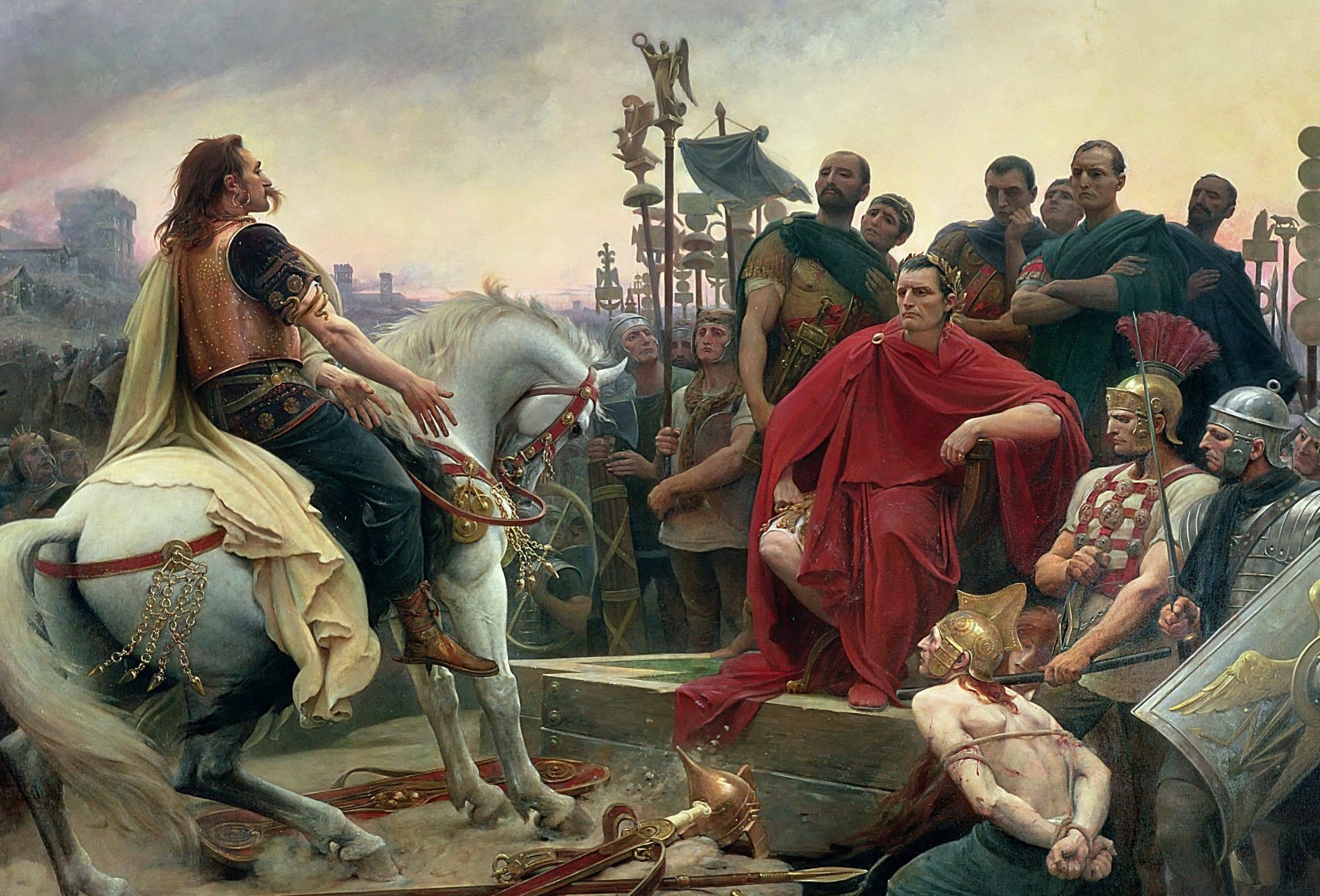
Through this, the public’s disdain of the ruling elites surmounts, and soon enough, a single, popular leader emerges. Comparing The Republic with the biography of Caesar reveals striking similarities:
“The mob will do anything he tells them, and the temptation to shed a brother’s blood is too strong. He brings the usual unjust charges against him, takes him to court and murders him, thus destroying a human life, and getting an unholy taste of the blood of his fellow. Exiles, executions, hints of cancellation of debts and redistribution of land follow, till their instigator is inevitably and fatally bound either to be destroyed by his enemies, or to change from man to wolf and make himself tyrant.”22
While it’s not a neat one-to-one, Caesar satisfies many of Plato’s conditions: he became a champion of both his soldiers and the common man; he waged a civil war against Pompey; he would choose clemency over exile and execution, however, he was willing to exercise both if necessary; he forgave debts and redistributed land; but moreover, he stamped coins with his image, dressed himself in purple, and erected a statue of himself among those of the ancient kings.23
As With One, So With All
Although entirely distinguished, the figure of Caesar is a frame through which we can understand human history. His ascension to power, achievements in politics, and behaviors in prosperity illustrate not only his personal character, but the greater dynamics of human nature. As Carlyle writes, “whatsoever the general mass of men contrived to do or to attain; all things that we see standing accomplished in the world”, are those very accomplishments that Great Men like Caesar actually attained.
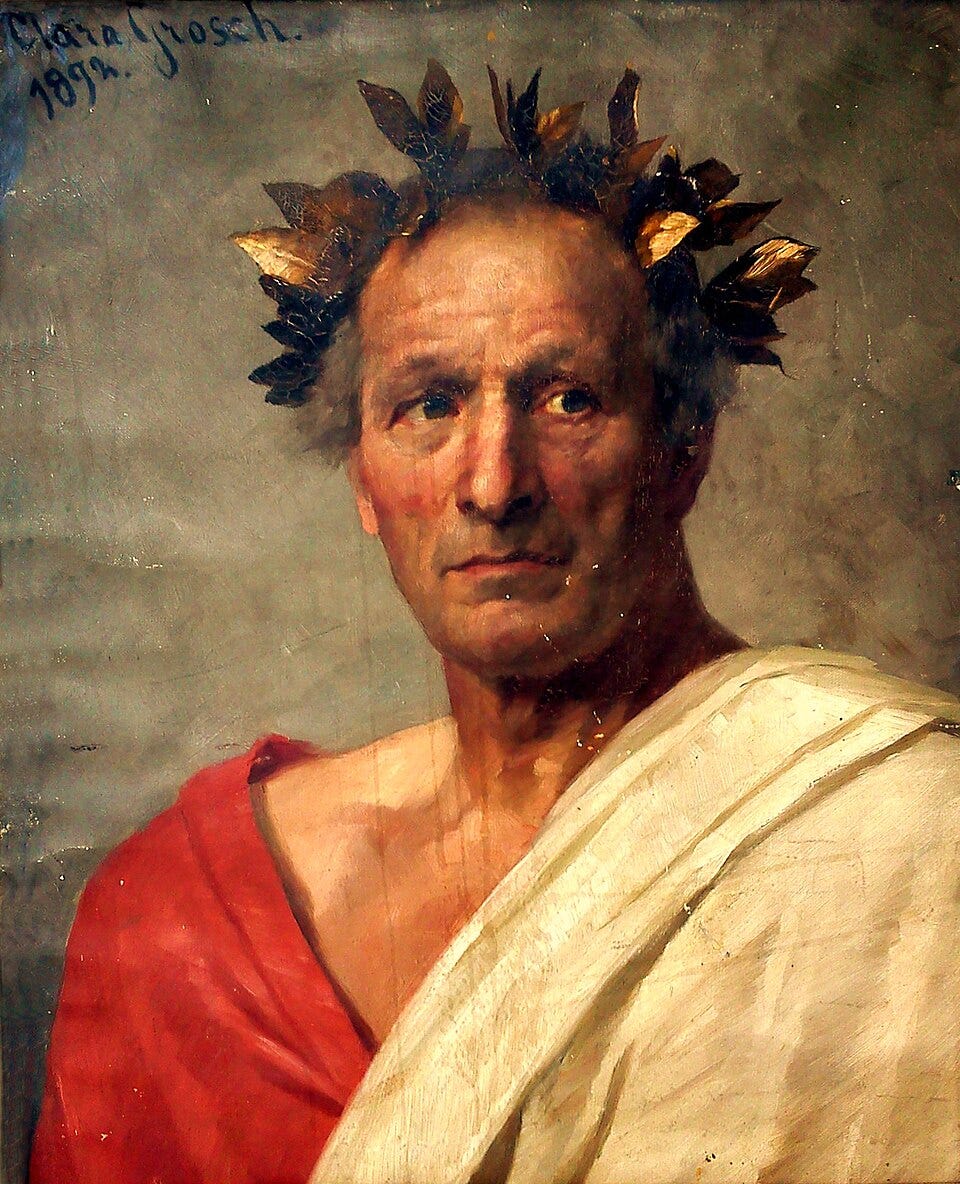
He is an exception to the norm, a giant amongst common men; but in this, he represents the ideal toward which every individual aspires. As with one, so with all: Caesar’s personal ambitions and quest for self-actualization embodies the wants of everyone. As Maslow writes, “A musician must make music, an artist must paint, a poet must write, if he is to be ultimately happy. What a man can be, he must be.”24
Although he reached uncommon heights, Caesar remained human, all too human.
Conclusion
If Rome’s decline and fall is one of history’s great dramas, then Caesar’s assassination is one of its great tragedies. “It was a tragedy,” Durant writes, “in the sense that probably both parties were right: the conspirators in thinking that Caesar meditated monarchy, Caesar in thinking that disorder and empire had made monarchy inevitable.”25
Rome chose Caesar. Rome murdered Caesar. Rome mourned Caesar.
One cannot look upon Caesar without making modern parallels. Doubtless his biography may illuminate our present crisis in a way that neither the pundits nor the press may ever actually do. For they ceaselessly clamor for attention; while the dead bear silent, indisputable testimony.
Shall we choose a Caesar? Are we slaves to self-fulfillment? Is modern man any different from his forebears? May we learn?
Indeed, such questions have answers.
If only we could listen…
“Very few, indeed, of the assassins outlived Caesar for more than three years, or died naturally. All were condemned to death under the Pedian Law, and all met it in different ways—some in shipwreck, some in battle, some using the very daggers with which they had treacherously murdered Caesar to take their own lives.”
—Suetonius26
Thanks for Reading—Stay Tuned for More
Consider supporting with a Like, Share, or Restack. Each recommendation helps reach readers interested in history, meaning, and the questions of civilization.
Have a strong, thoughtful week.
Ancient wisdom for unprecedented times.
Thomas Carlyle, “On Heroes, Hero-Worship, and the Heroic in History” (1840), quoted in Fritz Stern, ed., The Varieties of History: From Voltaire to the Present (New York: Vintage Books, 1973), 103.
Will Durant, Caesar and Christ: A History of Roman Civilization and of Christianity from their beginnings to A.D. 325 (New York: Simon and Schuster, 1972), 167.
Ibid.
Plutarch, The Parallel Lives: The Life of Julius Caesar, trans. Bernadotte Perrin, accessed July 7, 2026, University of Chicago Penelope edition, editor's note 5.
Suetonius, The Twelve Caesars, trans. Robert Graves (London: Penguin Books, 1970), 10, para. 2.
Ibid., 31-32.
Durant, Caesar and Christ, 168.
Ibid., 169.
Plutarch, The Parallel Lives: The Life of Julius Caesar, trans. Perrin, para. 2.
Durant, Caesar and Christ, 169.
Suetonius, The Twelve Caesars, 35, para. 57.
Plutarch, The Parallel Lives: The Life of Julius Caesar, trans. Perrin, para. 2.
Durant, Caesar and Christ, 170.
Ibid.
Ibid., 178.
Ibid., 179.
Plato, Republic, trans. Desmond Lee, 2nd Penguin Classics ed. (London: Penguin Books, 2007), 299 (562b).
Ibid., 299 (562c).
A. H. Maslow, “A Theory of Human Motivation,” Psychological Review 50 (1943): 370–96, accessed July 7, 2026, Classics in the History of Psychology
Ronald Inglehart, Modernization and Postmodernization: Cultural, Economic, and Political Change in 43 Societies (New Jersey: Princeton University Press, 1997), 4.
Plato, Republic, trans. Lee, 300 (563d).
Ibid., 303 (565e–566a).
Durant, Caesar and Christ, 195.
Maslow, “A Theory of Human Motivation.”
Durant, Caesar and Christ, 198.
Suetonius, The Twelve Caesars, 49, para. 89.
This is an important piece because it tells us the historical pattern we now live under. Plato was right, as history demonstrates. These "great men" have caused more hardship, grief, and destruction than the lesser-known champions of peace. In America, lack of accountability has led to
pointless wars and disruption of the rule of law. Einstein said it best, "Three great forces rule the world: stupidity, greed, and fear." Thank you for another insightful essay.
Brilliant dissection of Caesar and the state of the late republic, Caesar once described the late republic as a “name without body or form”, essentially calling it a carcass. I always wonder whether Caesar from his youth planned his rise to imperial rule meticulously or whether machiavellis “fortuna” played majority of the moves.